

Introduction
The transition from college to job can be scary and unpredictable. You might not know what to do or why you should even invest in an English major if it is such a broad field that requires such training experience. However, by analyzing the job ads that are present in multiple different job sites, we can collect data that shows the importance of a writing degree.
In this project, we collected about 100 different job ads and “coded” them. Coding is a process in which we determined what proficiencies job ads were looking for and notated it. We eventually collected all of this data and put all of the codes together to analyze. From this data, I presented the top 6 codes taken within each separate category, showing what we can learn in preparation. The three categories were tool/technologies, professional competencies, and personal characteristics.I also looked at the numbers of each separate category of codes and deduced based off of the highest number what the most sought-after category was: professional competencies. However, these are the types of proficiencies that creative classes will help you achieve. Based on the data of this project, creativity is part of what makes us as writers thrive in a learning environment and truly allows us to grow in our skills. Many of the classes I have taken at the University of Northern Colorado have had a sort of ratio to them. They usually involve some sort of skill to learn, creativity to fill out and enforce this skill, and collaboration to refine it. It is my belief that these are the types of classes that people need to take to get far in their career. This is what matters over the hesitation that a writing degree won’t get you a good job in your future. In fact, the data we collected suggests quite the opposite. We only looked at entry-level creative-based jobs. This data allows us to be comfortable in the major that we choose while also getting to use our passion in a way that refines our skills for success in the start of our careers after graduation.
This research is essential to keep writing alive. It is a dying degree in colleges, even though it is so important to the world. Writing is used in everything. So many people think that other degrees are becoming more relevant, that writing is just for the dreamers with enough passion to make it. But writing is a solid career path, and this data proves it. It’s not simply hopes and dreams anymore. There is hard tangible evidence that “English” jobs are still alive and still very attainable. This is a career where we can prepare for the future, and where schools can teach us what we need to learn. For example, at the University of Northern Colorado, the Writing, Editing, and Publishing (WEP) program hosts a variety of classes that are excellent mixes of learning a proficiency needed for the “real world” and staying within a creative framework, which, as discussed later in this report, is essential to the growth of students into prospective job candidates.
This report will discuss how our project worked, present the data that was collected and analyzed, and discuss what these results mean (represented as Methodology, Data Analysis, and Data Discussion).
Methodology
This class focuses on the jobs that we, as English majors, would like to have when we graduate college and are forced into the real world. Fittingly, our first project is a follow up on Brumberger and Lauer’s report that analyzes Industry Job Postings, and the multiple occasions of this project that our professor, Dr. Marc Santos, has conducted. The goal of this project was to identify what the common tools and technologies, professional competencies, and personal characteristics are required in different job types (writer, editor, hybrid editor, social media, design, and marketing).
These jobs were collected by a set of excluding media, meaning that we had a relatively broad possibility of jobs to add. We excluded ads that called for experience in television production (especially on-air), experience as a field journalist, degrees in finance or accounting, extensive experience with Customer Relationship Management software, required a client log, management or hiring experience, back-end coding skills, extensive graphic design portfolios, 5 or more years of experience, any telemarketing jobs, and any part-time or unpaid intern positions. We were also limited to specific sites to find these jobs (LinkedIn, Indeed, or MediaBistro, because these sites included more jobs in the creative aspect of our field while also allowing us to search through filters and therefore find jobs that matched the criteria while still giving us different options). These parameters are relatively loose but fitting for the purposes of our project. This class’s main goal is to find each of us would be the most interesting job outside of graduation. Therefore, the loose parameters are instead a means of exploration; a way to see what that sparks interest within us is out there, and to learn from, and possibly even be inspired by the interests of others. Some might call it sloppiness, but it’s important to have broad parameters when thinking about our future.
The analytical framework used for this project originally lies within Brumberger and Lauer’s “The Evolution of Technical Communication: An Analysis of Industry Job Postings,” originally written in 2014. However, this specific report focuses on “technical communication.” This term is meant (both by them and by Dr. Santos) as a “more precise sense of developing documentation (instruction manuals), product testing (usability reports), and working with scientific experts to communicate scientific/technical knowledge.” This description is not necessarily fitting for our purposes with this project, so we have changed our process of data analyzation to better fit the intentions of finding an interesting job for our futures. To analyze the jobs our class picked out, we created a chart of codes (similar to Brumberger and Lauers). These codes detailed the specifics within the realms of tools and technologies, professional competencies, and personal characteristics, and ultimately provided a condensed list of the most important things that jobs are looking for in new prospective candidates.
In this class, each student contributed about 4 different job advertisements to the project, resulting in 90 jobs total.This alone makes a major difference in results for this particular project, as the previous jobs were collected and coded by Santos. From there, we used this coding system (mentioned earlier) to identify these different aspects and competencies of a candidate that each specific job was looking for. We then had two rounds of editing from both our peers and our teacher where we split up into teams and co-edited a list of about five job advertisements together to ensure accuracy, and the codes were all added into a shared spreadsheet. This process ensured a quality outcome of our project while still ensuring it was universal and diverse enough for all students. Therefore, with all of the job ads and their corresponding codes within the same spreadsheet, we have successfully cultivated this project and will be able to see what areas are important for the jobs that we, as students, will be considering as we inch closer and closer to our careers.
Data Analysis
Within this project, a total of 90 job ads were collected. Like I mentioned previously, we took each job ad and “coded” them. These codes belonged to three different categories, and were applied to each advertisement to determine what the most sought-after tools/technologies, professional competencies, and personal characteristics are in the working world. These codes are listed below to demonstrate the range of codes that were applied to these job ads.
| Tools and Technologies | Professional Competencies | Personal Characteristics |
|---|---|---|
| Adobe Premiere, videography (AP) | Communication - Oral (CO) | Analytic/Critical Thinking (ACT) |
| Adobe Illustrator, graphic design (AI) | Communication - Written (CW) | Collabration, Group Work (GW) |
| Adobe photoshop, image editing (API) | Communication - Visual; design, photography (CV) | Creativity (C) |
| Adobe InDesign, publishing software (AID) | Editing (E) | Detail Oriented (DO) |
| HTML | Project Management (PM) | Flexibility (F) |
| Content Management Systems (CMS) | Research (R) | Independence, Initiative (I) |
| Google Docs (GD) | Style Guide; Professional Standards, AP (SG) | Interpersonal (IN) |
| Customer Relationship Management Software (CRM) | Specific Subject Matter Familiarity (SSMF) | Leadership, Management (LM) |
| Microsoft Office (MSO) | Translating Complex/Scientific Material (TC) | Learning (L) |
| Microsoft Excel (MSE) | Usability and Testing (UT) | Multitasking (M) |
| Social Media Experience (SM) | Key Performance Indicators, Business Analysis (KPI) | Organization (O) |
| Social Media Management (SMM) | Search Engine Optimization; web metrics, analysis (SEO) | Problem Solving (PS) |
| Email, Advertising Tech (AT) | Journalism, interviewing (J) | Time Management, Deadlines (TMD) |
| Podcasting, audio editing (POD) | Bilingual (BI) | |
| Data Management (DM) | ||
| Project Management Tools (PMT) |
This table shows the same information that we were given to code the broad range of job ads collected into our folder. There were a total of 970 total codes taken down (after our thorough comb-through). Approximately, 25.1% of these codes belong to tools and technologies, 40.1% to professional competencies, and 34.8% to personal characteristics. These results are clarified and more deeply analyzed by the following graphs.
Graph 1
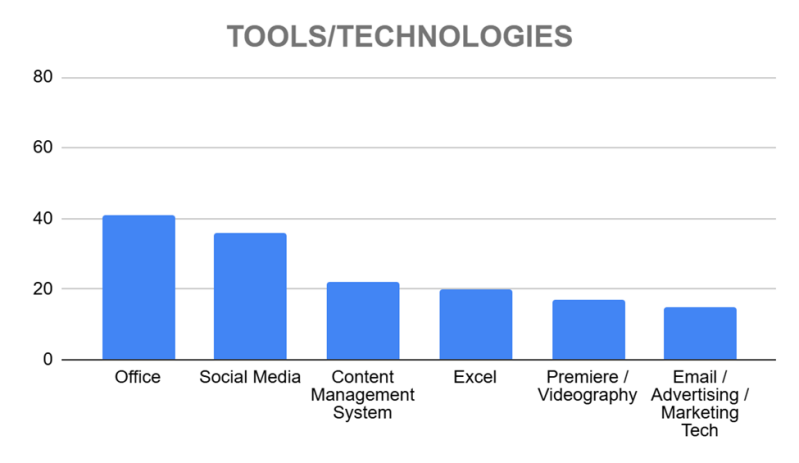
This chart looks at the 6 highest number of codes within the category of Tools and Technologies, highlighting the most important tools that job ads are looking for in their prospective candidates.
Out of the 243 total codes collected within the tools and technologies category, 151 of them belong to Microsoft Office, Microsoft Excel, social media experience, content management systems, videography, and marketing, making up 62.1% of the total codes collected within this category.
However, when we compare the amount of codes taken for this category compared to the next two (shown in the next two graphs), we can see that these technologies are not near as requested as professional competencies and personal characteristics. This is because of how we narrowed our search, resulting in more creative, entry-level jobs. These technologies become more important as you gain experience and can start applying for the higher positions that require an expertise within the different tools/technologies.
Graph 2
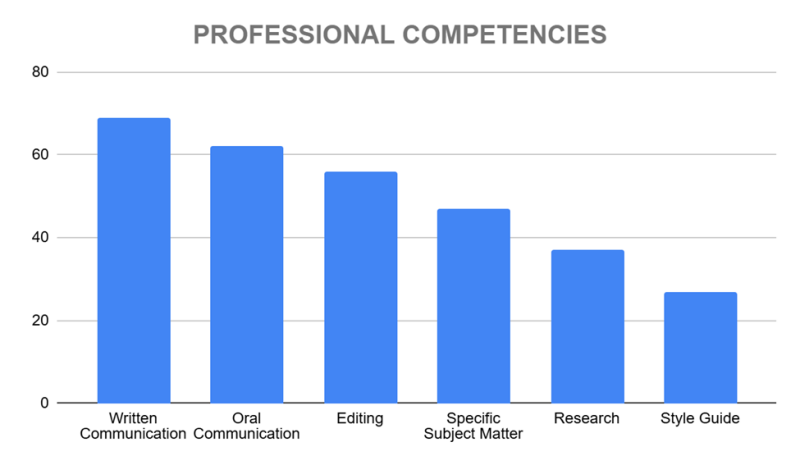
This next chart looks at the 6 highest number of codes within the category of Professional Competencies, highlighting the top requirements within the working world.
Out of the 389 total codes collected within the professional competencies category, 298 of them belong to written communication, oral communication, editing, specific subject matter familiarity, research, and style guide, making up 76.6% of the total codes, and therefore the top 6 professional competencies sought after in our collected job ads.
In addition, with the total number of codes taken were highest in this category, we can deduct that professional competencies are the most sought-after category of skills in an entry-level employment opportunity, which are easily attainable for the graduates of English programs who are willing to learn, if it hasn’t already been taught to them through their classes in college.
Graph 3
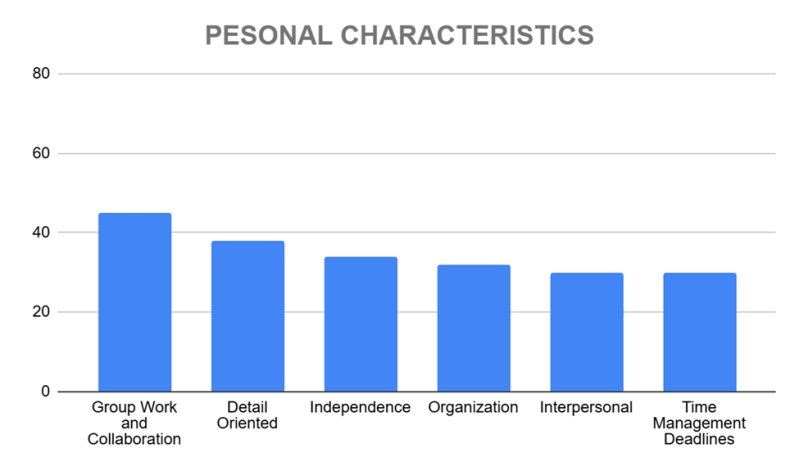
Our last graph exhibits the top 6 highest number of codes within the category of personal characteristics, highlighting the most important characteristics within the range of job ads collected.
Out of the 338 total codes collected within the personal characteristics category, 209 belong to group work, detail orientation, independence, organization, interpersonal, and time management, making up 61.8% of the total codes collected.
However, personal characteristics are tricky; they can be completely relative, and depend heavily on how a company wants a certain person to mesh with the other people in the company. This speaks to the relevance or personal characteristics to an interview, which I think is reflected in the total codes retrieved. This category has the second highest total number of codes collected, which already portrays a relative and diminished position. However, it has the lowest percentage that is represented by the top 6 personal characteristics, indicating that the importance is much more distributed within this category of codes, further showing a relative and diminished position within job ads.
These graphs illustrate the two most important results of this project. First off, they show the important things that we, as aspiring English students, can anticipate and learn on our way towards the working world. It is a reassurance that there are measures we can take to ensure our success, while staying realistic of what we should be aiming for. We can further pinpoint where our efforts are going based off of the second result. Professional Competencies make up the highest percentage of all of the codes taken, showing the most importance placed in those types of proficiencies. Because we were looking exclusively at entry-level jobs, we can see a raised importance in the very things that college is designed to teach you. What we don’t see with the graphs is the information we get from the raw data sheet (https://docs.google.com/spreadsheets/d/1QCJYjFM5U-_XjJ-NihMWsdo0hVrXfgoX8FyC0f0C7No/edit?usp=sharing), which organizes every job ad gathered into a specific career category. The categories were editors, hybrids, marketing, social media, and writing. We can see the specific codes pulled for each category of these jobs. This helps us focus on our goals and what we want to be when we grow up, so to speak. We can look at what people look for in a writer and focus on the specifics within that category, only furthering our potential as a job candidate.
Data Discussion
This data was founded on a project that was originally crafted by Brumburger and Lauer, who had a much broader search range and drafted results that focused on technical writing, as that is the most prevalent job available within the set of “english” job opportunities. However, as mentioned before, there are some distinct differences in the parameters to our respective projects. We instead chose to keep limitations low, but fitting for the creative focused entry-level jobs we were hoping to find.
The purpose of this class has been to prepare us and give us a realistic depiction of what a job out of graduation really looks like. Out of all of the different teachers that I have worked with and talked to, none have discredited creativity; instead they call it important. As liberal arts have swept the nation and even become a part of a lot of our colleges, the importance of creativity has increasingly grown in the working world especially. A lot of this comes into play with the rising technologies such as social media and as the generational gaps grow. There is a lot of creativity required in a social media manager when it comes to creating new content and reaching the right audience. There’s a lot of creativity that goes into writing in general, and that quality is finally being prompted. I believe this is the main reason why our project is so distinct in our results.
This study was designed to show what different companies are looking for in a prospective candidate to plan for our futures and learn what we want to be and how we should shape the specifics of our school experience to sharpen these skills. The results of this study have shown us exactly what we can focus on and learn. With the university’s classes and available resources, I have already learned the top 6 professional competencies (shown on graph 2), and I still have much to learn.
Something I have noticed about this school is that within the Writing, Editing, and Publishing (WEP) major, the classes usually center around some sort of skill, creativity to round out that skill, and then collaboration to refine that skill. Taking these classes has been imperative to my growth as a writer and an English student, and they will continue to help me grow until I have enough skill to graduate and enter the workforce prepared and aimed for success. These are the classes that are the most important to students in the WEP program; they are what prepare us for our future. Some of the classes that I have found beneficial have been listed below:
ENG123 - Writing and Research Methods
([when I took this class] titled: College Research Paper)
ENG220 - Writing, Transformation, and Change
ENG327 - Editing and Publishing Elective
([when I took this class} titled: Editing for Print Publication)
ENG123 taught me research and subject style familiarity, but made us use creativity by turning the subject of our papers into something personal to our interests that would spark a passion in our research and familiarity with the subject. I ended up writing about literary theory to deconstruct the three different waves of feminism, but I learned how to research well and familiarize myself with the subject material. In ENG220, written and oral communication was enforced by analyzing different ways that underground subcultures communicated with each other, and then replicated ourselves. We also got slight experience with internet and social media communication in this class. In ENG327, we learned the rules of editing by practicing on our own material. This class not only sharpened my editing and style guide proficiencies, but cleared up my own writing as well. This specific teacher also gave us resources to access courses for editing certificates; something to add to our resume.
Those are the six highest requested professional competencies in only three classes. It is safe to assume that the addition of creativity into a learning environment grows these skills, and therefore grows a successful program. Each of these classes fits the ratio of skill, creativity, and collaboration that I described in depth earlier, and each one has taught me a valuable proficiency that I can carry with me into the looming working world. These are the types of classes that will benefit a WEP major and set them up for success while also keeping the part of them that feeds their passion alive. This is what sets our major apart and makes it so beneficial for an aspiring writer.
Conclusion
Writing is an art. Like all arts, it is centered in creativity and passion. But the rigid side of learning writing embraced by these additional qualities is what makes our students and our program flourish. The results of this project showed what is important to learn for an entry-level creative writing position when we graduate. But the creativity in liberal arts schools (such as the University of Northern Colorado) is what makes us learn these skills and know how to apply them. A writing major will be successful in what they do because of this education experience, and they will be prepared for whatever job they choose when they graduate. The purpose of this report was to communicate the findings of a job study, but we were truly discovering the proficiencies that we can learn to prepare as much as possible towards success at a start in our chosen careers.
Add comment
Comments